Which Character Helps Anne and Her Family While They Are in Hiding
Anne Frank (12 June 1929 – February 1945)[one] was a German-born Jewish daughter who, forth with her family and four other people, hid in the second and third floor rooms at the back of her begetter's Amsterdam company during the Nazi occupation of the Netherlands. Helped by several trusted employees of the company, the group of viii survived in the achterhuis (literally "back-house", usually translated as "secret addendum") for more than two years earlier they were betrayed, and arrested. Anne kept a diary from 12 June 1942 until 1 Baronial 1944, three days before the residents of the annex were arrested. Anne mentioned several times in her writings that her sister Margot Frank likewise kept a diary, just no trace of Margot's diary was e'er found.
Later on spending fourth dimension in both Westerbork and Auschwitz, Anne and her elder sis Margot were somewhen transported to Bergen-Belsen, which was swept past a massive typhus epidemic that began in the camp in Jan 1945. The two sisters died, apparently a few days autonomously, sometime in February 1945.[ane] Both were buried in one of the mass graves at Belsen, though information technology is unknown to this twenty-four hours exactly which of the many mass graves at Belsen contains their remains. Their "tombstone" that tin be viewed at Belsen today is merely a memorial to the two sisters, and does not mark their bodily burial site.
Their begetter, Otto Frank, survived the state of war and upon his return to Amsterdam was given the diary his daughter had kept during their menstruum of confinement, which had been rescued from the ransacked achterhuis past Miep Gies (below) who, out of respect for Anne'due south privacy, had not read it. The diary was kickoff published in 1947, and by virtue of worldwide sales since then, it has go i of the most widely read books in history. Information technology is recognized both for its historical value as a document of the Holocaust and for the high quality of writing displayed past such a immature writer. In 2010, Anne was honored as one of the most iconic women of the year.[ citation needed ] She is besides one of the most well known victims of the Holocaust. Her friend Eva Schloss, who survived the Holocaust, became her stepsister after Anne Frank'due south decease.
The other occupants of the Secret Annex [edit]
- Otto Frank (12 May 1889 – 19 August 1980;[1] Anne and Margot'southward male parent, husband of Edith) was in poor health, due primarily to malnutrition, when he was left backside in Auschwitz with the residue of those in the ill billet, when the Nazis evacuated all the other prisoners on a death march[2] He survived until the Russians liberated Auschwitz shortly afterward.[3] In 1953, he married Elfride "Fritzi" Markovits-Geiringer, an Auschwitz survivor who lost her first husband and her son when they, too, were sent on a expiry march out of Auschwitz, and whose daughter Eva, also a survivor, was a neighborhood friend of the Frank sisters'.[4] Otto devoted his life to spreading the message of his daughter and her diary, every bit well as to defending information technology against Neo-Nazi claims that it was a forgery or false. He died in Birsfelden, Switzerland from lung cancer, on 19 August 1980 at the age of 91.[five] His widow, Fritzi, continued his work until her ain death in October 1998.
- Edith Frank (sixteen Jan 1900 – half-dozen Jan 1945;[i] Anne and Margot's female parent, wife of Otto) was left behind in Auschwitz-Birkenau when her daughters and Auguste van Pels were transferred to Bergen-Belsen, as her health had started to deteriorate. Witnesses reported that her despair at beingness separated from her daughters led to an emotional breakdown. They described her searching for her daughters endlessly and said that she seemed to non understand that they had gone, although she had seen them lath the train that took them out of the camp. They also said that she began to hoard what little food she could obtain, hiding information technology under her bunk to give to Anne and Margot when she saw them. They said that Edith Frank told them Anne and Margot needed the nutrient more she did, and she therefore refused to eat it. She died on vi January 1945 from starvation and exhaustion, ten days before her 45th altogether and 21 days before the camp was liberated.[ citation needed ]
- Margot Frank (sixteen February 1926 – Feb 1945[1]) died of typhus in Bergen-Belsen. According to recollections from several eyewitnesses, this occurred "a few days" before Anne'south death, virtually probable in early-mid February 1945, though like Anne'due south death, the exact engagement is not known.
- The Van Pels family joined the Franks in their hiding place in concealed rooms at the rear of Otto Frank'southward function building, on thirteen July 1942. Anne gave the van Pels family a pseudonym in her diary (as she did for most other characters in her diary); she called them "Van Daan" in her diary. Although their helpers are today known almost exclusively by their own names, the Franks' young man occupants in the achterhuis retain their pseudonyms in many editions and adaptations of Anne'southward diary.[ citation needed ]
-
- Hermann van Pels (31 March 1898 – Oct 1944;[ane] known every bit Hans in the offset manuscript of the diary) was murdered in Auschwitz, beingness the first of the eight to die. He was the only member of the group to be gassed. However, according to bystander testimony, this did non happen on the day he arrived at that place. Sal de Liema, an inmate at Auschwitz who knew both Otto Frank and Hermann van Pels, said that after 2 or three days in the camp, Van Pels mentally "gave up", which was generally the starting time of the finish for whatever concentration camp inmate. He subsequently injured his pollex on a piece of work item and requested to be sent to the ill barracks. Soon after that, during a sweep of the sick barracks for option, he was sent to the gas chambers. This occurred about three weeks later his arrival at Auschwitz, most likely in very early October of 1944, and his pick was witnessed by both his son Peter and by Otto Frank.[ commendation needed ]
- Auguste van Pels (29 September 1900 – April 1945;[i] known as Petronella in the diary), born Auguste Röttgen (Hermann'due south wife), whose date and place of death are unknown. Witnesses testified that she was with the Frank sisters during part of their time in Bergen-Belsen, but that she was non present when they died in February/March. According to German records (her registration carte du jour), Mrs. Van Pels was sent to Bergen-Belsen concentration campsite in Germany with a grouping of 8 women on November 26, 1944. Hannah Goslar's testimony was that she spoke to Mrs. Van Pels through the barbed wire fence "in late Jan or early on Feb". Auguste was transferred on February 6, 1945 to Raguhn (Buchenwald in Germany), and so to the Czechoslovakia military camp Theresienstadt ghetto on Apr 9, 1945. This same card lists her equally being alive on Apr 11, 1945. As such, she must have died en route to Theresienstadt or shortly after her arrival there, the date of her death occurring near probable the either the offset half or mid-Apr 1945, but earlier May 8, 1945, when the camp was liberated.[6] [7] Rachel van Amerongen-Frankfoorder, eyewitness of Auguste'due south death, states that the Nazis murdered her by throwing her onto the railroad train tracks during her last send to Theresienstadt in April of 1945.[viii]
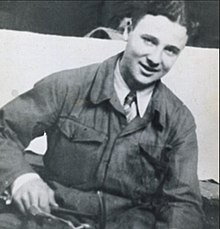
Peter van Pels wearing a (barely visible) Star of David; photo May–July 1942
-
- Peter van Pels (8 November 1926 – 10 May 1945;[1] Hermann and Auguste's son, known as Peter in the diary and Alfred in the first manuscript) died in Mauthausen. Otto Frank had protected him during their menstruation of imprisonment together, equally the ii men had been assigned to the aforementioned work group. Frank later stated that he had urged Peter to hide in Auschwitz and remain backside with him, rather than gear up out on a forced march, but Peter believed he would accept a better chance of survival if he joined the death march out of Auschwitz. Mauthausen Concentration Camp records indicate that Peter van Pels was registered upon his arrival there on January 25, 1945. Four days later, he was placed in an outdoor labor group, Quarz. On 11 April 1945, Peter was sent to the ill barracks. His exact expiry engagement is unknown, simply the International Cerise Cross stated that it was May 10, 1945, five days after Mauthausen was liberated by men from the 11th Armored Division of the U.South. 3rd Army. He was 18 years old, and was the last member of the group to die while imprisoned.
- Fritz Pfeffer (30 Apr 1889 – 20 December 1944;[one] family dentist of Miep Gies and the van Pels,[ix] and known as Albert Dussel in the diary) died on 20 December 1944 in Neuengamme concentration camp. His crusade of death was listed in the camp records as "enterocolitis", a grab-all term that covered, amidst other things, dysentery and cholera, both of which were common causes of decease in the camps. Of all the stressful relationships precipitated past living in such close proximity with each other for ii years, the relationship between Anne and Fritz Pfeffer was one of the most difficult for both, as her diary shows.
The helpers [edit]
- Miep Gies saved Anne Frank's diary without reading it. She subsequently said that if she had read it, she would take needed to destroy information technology, as it independent a great deal of incriminating data, such as the names of all of the annex helpers, likewise as many of their Dutch Underground contacts. She and her husband, Jan, took Otto Frank into their home, where he lived from 1945 (afterwards his liberation from Auschwitz concentration camp) until 1952. In 1994, she received the "Order of Merit" of the Federal Commonwealth of Deutschland, and in 1995, received the highest award from the Yad Vashem, the Righteous Among the Nations. She was appointed a "Knight of the Gild of Orangish-Nassau" past Queen Beatrix of holland. In 1996, Gies shared an Academy Award with Jon Blair for their documentary Anne Frank Remembered (1995), based largely on Gies' 1987 book of the same title. She too wrote the afterword for Melissa Müller'south biography of Anne Frank. Gies stated that every year she spent the unabridged solar day of 4 August in mourning, the appointment those in the Annex were arrested. Gies died on xi January 2010, following a short illness, at the age of 100.
- January Gies (Miep'due south husband) was a social worker and, for part of the state of war, a member of the Dutch Resistance; thus, he was able to procure things for the people in the addendum that would have been about impossible to obtain whatsoever other fashion. He left the Underground in 1944, when an incident caused him to believe his safety had been compromised. Jan died of complications from diabetes on 26 January 1993 in Amsterdam. He and Miep had been married for 51 years.
- Johannes Kleiman (known every bit Mr. Koophuis in Anne'southward Diary) spent about half dozen weeks in a piece of work campsite later his arrest and was released afterward intervention from the Cherry Cross, because of his delicate health. He returned to Opekta and took over the firm when Otto Frank moved to Basel in 1952. He died at his office desk of a stroke in 1959, aged 62.[ citation needed ]
- Victor Kugler spent seven months in various work camps and escaped into a farm field in March 1945, during the defoliation that resulted when the prisoner march he was on that day was strafed by British Spitfires. Working his way back to his hometown of Hilversum on foot and by cycle, he remained in hiding there until liberated by Canadian troops a few weeks after. Afterwards his married woman died, he emigrated to Canada in 1955 (where several of his relatives already lived) and resided in Toronto. On September sixteen, 1958 he appeared on To Tell the Truth, equally "the hider" of Otto and Anne Frank. He received the "Medal of the Righteous" from the Yad Vashem Memorial, with a tree planted in his honour on the Boulevard of the Righteous Among the Nations in 1973. He died on 16 December 1981 in Toronto, subsequently a long disease, at the age of 81.[ citation needed ]
- Bep Voskuijl, like her colleagues, was instructed to stay in the role on the mean solar day the Franks were forced from their hiding place, simply in the defoliation that followed, Bep managed to escape with a few documents which would have incriminated their blackness market contacts. Bep and Miep found Anne's diaries and papers after the 8 prisoners, together with Kugler and Kleiman, had been arrested and removed from the edifice. Bep left Opekta shortly after the war and married Cornelius van Wijk in 1946. While she did grant an interview to a Dutch magazine[ citation needed ] some years after the war, she generally shunned publicity. Nonetheless, Bep kept her own scrapbook of Anne-related manufactures throughout her life. Bep and her hubby had four children, the terminal a daughter whom she named "Anne Marie", in laurels of Anne. Bep died in Amsterdam on 6 May 1983.[ citation needed ]
- Johannes Hendrik Voskuijl, Bep'southward father, was lauded constantly by the eight in hiding every bit a tremendous help with all matters during their early days in the achterhuis. For instance, he designed and built the "swinging bookcase" that concealed the entrance to the annex. However, Anne often mentioned his health issues in her diary, and he became incapacitated later on a diagnosis of abdominal cancer. He ultimately died of the disease in tardily Nov 1945, and Otto Frank attended his funeral on Dec i.[ citation needed ]
Friends and extended family unit [edit]
- Hanneli Goslar (born 12 November 1928), known equally "Hannah" and to most of her childhood friends every bit "Lies", was Anne's oldest friend, along with Sanne Ledermann. While Hannah was in Bergen-Belsen, she met Auguste van Pels by asking through a hay-filled spinous wire fence if anyone who could hear her voice spoke Dutch. Mrs. van Pels answered her and remembered Hannah from peacetime in Amsterdam. Mrs. van Pels so told Hannah that Anne was a prisoner in the department of the camp van Pels herself was in. Hannah was astonished, as she, like most people back in Amsterdam, believed the Franks had escaped to Switzerland. Hannah was able to talk to Anne several times through the barrier and to toss some essentials over it for her.[nine] Anne had told Hannah, at this point, that she believed both of her parents were expressionless, and in later years Hannah reflected that if Anne had known her father were nevertheless alive, she might have found the strength to survive until the camp was liberated. Before long after Hannah threw the parcel over the fence for Anne, Anne's contingent of prisoners was moved, and Hannah never heard from her again. Hannah and her piddling sister Gabi were the only members of their family unit to survive the war, and Hannah was most expiry from typhus and tuberculosis when the Russians liberated the railroad train in which she and Gabi were beingness transported, reportedly to Theresienstadt. After recovering, Hannah emigrated to Israel, became a nurse, and ultimately a grandmother of 10.[10]
- Susanne "Sanne" Ledermann was Anne's constant companion from the time of her arrival in Amsterdam and is mentioned several times at the beginning of the diary. She was considered the "quiet" i of the trio of "Anne, Hanne and Sanne". She was very intelligent, and according to Anne, very facile with poesy. Sanne's full first proper noun is variously listed in different sources as both "Susanne" and "Susanna". Simply her friends chosen her "Sanne"; her family used the more Germanic "Susi". After his return to Amsterdam, Otto Frank learned that Sanne and her parents, Franz and Ilse, were arrested on xx June 1943. Sanne and her parents were sent first to Westerbork, then on 16 November to Auschwitz, where all three were gassed upon arrival. Sanne'southward sister Barbara Ledermann, who was a friend of Margot's, had, through contacts in the Dutch Hole-and-corner, acquired a German ID carte du jour (becoming "Barbara Waarts") and worked as a courier for the Underground.[ citation needed ] She survived the war and later married the Nobel Prize–winning biochemist Martin Rodbell.
- Jacqueline van Maarsen (born xxx Jan 1929), or "Jacque", as she was known to anybody, was Anne's "best" friend at the time the Frank family went into hiding. Jacque sincerely liked Anne, merely at times found her too demanding in her friendship. Anne, writing later in her diary, was remorseful for her ain attitude toward Jacque, regarding with better understanding Jacque's desire to accept other close girlfriends also - "I but want to apologize and explicate things", Anne wrote. After two and a half months in hiding, Anne composed a farewell letter to Jacque in her diary, vowing her lifelong friendship. Jacque read this passage much later, later the publication of the diary. Jacque'due south French-born mother was a Christian, and that, along with several other extenuating circumstances, combined to become the "J" (for "Jew") removed from the family unit's identification cards. The van Maarsens were thus able to alive out the war years in Amsterdam. Jacque subsequently married her childhood sweetheart Ruud Sanders and nevertheless lives in Amsterdam, where she is a bookbinder and has written four books on their notable friendship: Anne and Jopie (1990), My Friend, Anne Frank (1996), My Name Is Anne, She Said, Anne Frank (2003), and Inheriting Anne Frank (2009).
- Nanette "Nanny" Blitz (born 6 Apr 1929) was some other schoolmate of Anne's. Nannette, by her own admission, was the girl given the made-upwardly initials "East. S." in the early pages of Anne's diary. While they were not always on the all-time of terms during school days (their personalities were much too similar), Nanny had been invited to Anne's 13th birthday political party, and when they met in Bergen-Belsen, their reunion was enthusiastic. With prisoners constantly being shifted around in the huge campsite, Nanny apace lost track of Anne. Nannette was the only member of her family to survive the state of war. While she was recovering from tuberculosis in a hospital immediately after the war, Otto Frank got in touch with her, and she was able to write and requite him some information nearly her encounter with Anne at Belsen. Nanette and her family unit, as of 1998, resided in São Paulo, Brazil. (Müller, p. 269).
- Ilse Wagner, whom Jacque van Maarsen described equally "a sweetness and sensible girl", is mentioned several times in the early on part of the diary. Ilse's family had a table tennis set, and Anne and Margot frequently went to her business firm to play. Wagner was the offset of Anne's circumvolve of friends to be deported. Along with her female parent and grandmother, she was sent to Westerbork in January 1943, and so to Sobibór extermination campsite, where all iii were gassed upon inflow on 2 April 1943. (Müller, p. 301).
- Lutz Peter Schiff: For all the admiring boys Anne was surrounded with during her school days, she said repeatedly in her diary that the only one she deeply cared about was Peter Schiff, whom she called "Petel". He was three years older than Anne and they had, according to Anne, been "inseparable" during the summertime of 1940, when Anne turned 11. Then, Peter changed addresses, and a new acquaintance slightly older than Peter convinced him Anne was "merely a child". Anne had several bright dreams of Peter while in hiding, wrote about them in her diary, and realized herself that she saw Peter van Pels, at least partially, equally a surrogate for Peter Schiff. Anne implies in her diary (12 January 1944) that Peter Schiff gave her a pendant as a souvenir, which she cherished from then on. Schiff was also a prisoner at Bergen-Belsen, though he was transported from in that location to Auschwitz before Anne and Margot arrived at Belsen. It is known for certain that he died in Auschwitz, although the exact date of his expiry is unclear.[ citation needed ] In 2009, the Anne Frank House received a photograph of Schiff as a boy, donated past ane of his former classmates; it tin be seen, along with the story of its donation, on the Anne Frank Firm website.
- Helmuth "How-do-you-do" Silberberg was the male child Anne was closest to at the time her family went into hiding, though they had only known each other virtually ii weeks at that fourth dimension. Born in Gelsenkirchen, Deutschland, his parents sent him to Amsterdam to live with his grandparents, believing, like Otto Frank, that Hitler would respect Holland' neutrality. Silberberg's grandfather, who disliked the name Helmuth, dubbed him "How-do-you-do". Hello was 16 and adored Anne, but she wrote in her diary that she was "not in dearest with Hello, he is simply a friend, or every bit mummy would say, one of my 'beaux'", though Anne as well remarked in her diary on how much she enjoyed Hello's visitor, and she speculated that he might get "a real friend" over time. By a very convoluted series of events, including several narrow escapes from the Nazis, Hello eventually reunited with his parents in Kingdom of belgium. Belgium was also an occupied land, nonetheless, and he and his family were still "in hiding", though not under circumstances as difficult as the Franks'. The American forces liberated the town where the Silberbergs were hiding on iii September 1944, and Hello was gratis — tragically on the same day that Anne and her family unit left on the last transport from Westerbork to Auschwitz. Hello emigrated to the United States after the war and was later on known as Ed Silverberg. He appeared as Ed Silverberg in the multimedia stage presentation well-nigh the Holocaust chosen, And And so They Came for Me. He died in 2015 at age 89.[eleven]
- Eva Geiringer (now Eva Schloss) shared a remarkably similar history with Anne. The Geiringers lived on the opposite side of Merwedeplein, the foursquare where the Franks' flat was located, and Eva and Anne were virtually exactly the same historic period. Eva was as well a close friend of Sanne Ledermann's, and she knew both Anne and Margot. Eva described herself as an out-and-out tomboy, and hence she was in awe of Anne'south fashion sense and worldliness, just she was somewhat puzzled by Anne'due south fascination with boys. "I had a brother, so boys were no large matter to me", Eva wrote. Simply Anne had introduced Eva to Otto Frank when the Geiringers first came to Amsterdam "and so you lot tin can speak German with someone", as Anne had said, and Eva never forgot Otto's warmth and kindness to her. Though they were acquainted on a first-name basis, Eva and Anne were non particularly close, as they had different groups of friends aside from their mutual close friendship with Sanne Ledermann. Eva'south blood brother Heinz was chosen upwards for deportation to labor camp on the same twenty-four hour period as Margot Frank, and the Geiringers went into hiding at the aforementioned time the Franks did, though the Geiringer family split up into ii groups to do so - Eva and her mother in 1 location, and Heinz and his begetter at another. Though hiding in 2 split up locations, all iv of the Geiringers were betrayed on the same solar day, almost three months before the Frank family was arrested. Eva survived Auschwitz, and when the Russians liberated Birkenau, the women's sector of the camp, she walked the mile-and-a-half distance to the men's camp to look for her male parent and brother, finding out much later that they had non survived the prisoner march out of Auschwitz. Simply when she entered the sick barracks of the men's army camp, she recognized Otto Frank and had a warm reunion with him. Eight years later, Otto married Eva's widowed female parent Elfriede (Fritzi) Geiringer, thereby making Eva a stepsister of Anne and Margot'south. Eva subsequently wrote her autobiography Eva'southward Story: A Survivor'southward Tale by the Stepsister of Anne Frank (1988),[12] which served as the inspiration for the evolution of a popular multimedia phase presentation well-nigh the Holocaust called And So They Came for Me. Eva also co-authored, with Barbara Powers, an autobiography targeted to younger readers and considered a suitable companion book to Anne's diary, titled Promise, in which she describes her family's happy life before going into hiding, and the experiences of living in hiding during the Nazi occupation, of going to the concentration camps, and finally, of going after liberation to the house where Heinz and their father had subconscious, to retrieve the paintings Heinz had hidden below the floorboards in that location. Heinz's paintings have been displayed in exhibitions in the United states and are at present a part of a permanent exhibition in Amsterdam'southward war museum.[13] In 2013, Eva Schloss' memoir of life subsequently the Holocaust, After Auschwitz: A Story of Heartbreak and Survival by the stepsister of Anne Frank, was published. Afterwards the state of war, Eva somewhen congenital a new life in London with her husband of 60 years, Zvi Schloss, with whom she has iii daughters.[14] In May 2013, she was featured on BBC Radio 4's Woman'due south Hour.[xv]
- Mary Bos was a schoolmate from Anne'due south Montessori school and an invited guest at Anne'due south 10th altogether party; in the well-known photo of that gathering, she is the very slender girl tertiary from the right.[16] Mary was a gifted creative person, whose drawings and paintings were much admired by her peers. She is mentioned in passing in Anne's diary, when Anne writes of dreaming that she and Peter Schiff are looking "at a book of drawings by Mary Bos". Mary and her parents had emigrated to the The states in February 1940. When they left, Anne wrote Mary a little verse form equally a cheerio note. Mary almost forgot most Anne, but after the war, when Anne's diary was published, she recalled her friend Anne from Montessori schoolhouse. Later the war, Mary wed Bob Schneider. They all the same live in the Us.[17] After Anne's diary was start published in 1947, Mary finally learned of Anne's fate.[18]
- Käthe "Kitty" Egyedi was another lifelong friend of Anne'southward and was, like Mary Bos, a fine creative person. (Kitty remained a lifelong friend of Mary Bos'; they communicated regularly by letter, even after Mary moved permanently to the The states in 1940[ citation needed ]). Schoolmates at Montessori, Anne and Kitty attended different schools after 6th grade, and hence they had drifted apart somewhat. But soon before the Franks went into hiding, Kitty visited Anne one day when Anne was in bed with a slight fever. They chatted the whole afternoon, and Kitty was impressed and pleased that the shrill, blunt, and male child-crazy friend she remembered from Montessori school had begun to mature into a somewhat more than introspective and thoughtful girl. This drew them closer together once more. In the picture show of Anne'south 10th birthday referenced above under "Mary Bos", Kitty is the girl in the center with the dark pleated skirt.[sixteen] Kitty never felt that Anne was specifically thinking of her when addressing her diary passages to "Kitty", and most Anne scholars and biographers concur, believing that Anne borrowed the name from Cissy van Marxveldt's Joop ter Heul books (these were a great favorite of Anne'south, and Joop'south best friend was a graphic symbol named "Kitty Francken"). Kitty'south unabridged family unit survived internment at Theresienstadt, and, following her father's profession, Kitty became a dentist after the war. (Müller p. 290).
- Lucia "Lucie" van Dijk was a Christian friend from the Montessori school. Lucie's mother was an adamant member of the NSB until the end of the state of war, but Lucie'due south disillusioned father left the party in 1942. Anne was shocked when the van Dijks became party members, only Otto Frank patiently explained to her that they could nonetheless be good people even if they had distasteful politics. Lucie herself was briefly a rather conflicted and nervous member of the Jeugdstorm (Nazi youth grouping), but betwixt her begetter's later on abandonment of the political party and her grandmother's absolute abhorrence of anything connected with National Socialism, Lucie dropped out of the Jeugdstorm in belatedly 1942. She married afterwards the war and has lived her whole life in Amsterdam.[ citation needed ] In the grouping flick of Anne's 10th birthday party, Lucie is the girl on the extreme left.[16]
- Rie "Ietje" Swillens was another good friend of Anne'due south all the way through Montessori school. Ietje was the daughter with whom Anne breathlessly shared the news concerning one of Anne'due south maternal uncles, who had been arrested by the Nazis and sent to labor camp (he after was released and emigrated to the United States). Beingness Christian, Ietje's family was able to live out the war in Amsterdam. Ietje became a instructor in afterward years and today lives in Amstelveen, outside of Amsterdam.[ citation needed ] She is the daughter second from right in the "10 birthday" film.[16]
- Juultje Ketellaper and Martha van den Berg are two other childhood friends of Anne's who appear in the movie of Anne's tenth birthday party. Very piffling is known about either girl. Juultje, the very tall girl almost the eye, was gassed past the Nazis in Sobibór.[16] She may have been a Montessori schoolmate of Anne's or only a neighborhood friend. Martha, on the far right in the photograph, survived the war. Martha was Anne'southward Montessori schoolmate and is seen in another moving-picture show with Anne taken during Anne's last term at Montessori.[16]
- Hannelore "Hansi" Klein (Laureen Nussbaum) was exactly midway in age betwixt Anne and Margot. Hansi was an exception among those who knew Anne - she was rather indifferent nigh Anne and idolized Anne'southward sister Margot instead. But Anne, Hansi, and Hansi'southward 2 sisters performed in a holiday play near a vain princess who is punished with a long nose for her vanity, until she sees the mistake of her means. Anne played the princess; Hansi noted that she played the role to perfection and had "natural charisma". Most people felt that Margot was the more beautiful of the Frank sisters, but Hansi observed that Anne, in her opinion, was prettier than Margot considering "she [Anne] was always grin". Aside from those anecdotes, however, Hansi thought of Anne primarily as a noisy chatterbox, and "a shrimp", and she was surprised and impressed with Anne's inner depth upon reading the diary much later. Hansi married a young physician afterward the state of war and, upon emigrating to America, changed her first name to "Laureen". She ultimately became a professor of foreign literature and languages at Portland State University.
- Gertrud Naumann was a friend, companion, and occasional babysitter of Anne and Margot's in Germany. Although several years older than Margot, this friendly girl always played with both of the Frank sisters, and she was a neighborhood favorite of both Mr. and Mrs. Frank'due south. After the Franks moved to Amsterdam, Gertrud kept contact with them through letters. Being Christian, Gertrud and her family were able to avoid persecution in the war. Gertrud was one of the first friends in Frg with whom Otto Frank got in impact afterwards the war. In 1949, Gertrud married Karl Trenz. She died in 2002 at the historic period of 85.[ citation needed ]
- Bernhard (Bernd) "Buddy" Elias was a cousin of Anne'south who lived in Switzerland and a groovy favorite of hers. Four years older than Anne (and hence, even older than Margot) his rollicking sense of fun matched Anne'southward temperament perfectly, and he much preferred Anne every bit a playmate to the staid and proper Margot. Everyone called him "Buddy" except Anne, who ever chosen him "Bernd". He was a very talented ice skater, which Anne hugely admired. She even wrote an imaginary movie plot in her diary, wherein she would skate with Bernd, and included a sketch of the costume she would article of clothing. Later on a long career as a professional skater and actor, he somewhen became the head of the Anne Frank Fund in Basel (a separate arrangement from the Anne Frank Foundation in Amsterdam).(Müller, p. 270).
- Charlotte Kaletta, the common law married woman of Fritz Pfeffer, was not Jewish and therefore was able to remain in her Amsterdam flat during the occupation. Kaletta and Pfeffer had been regulars at the Sunday afternoon "coffees" hosted past the Franks earlier the war, and hence she knew the unabridged Frank family. Miep Gies was especially touched past the devotion Pfeffer and Kaletta displayed to each other, and often passed letters from ane to the other, an act which the other members of the household viewed as imprudent, just which Gies felt was important. Kaletta's Jewish husband died in Auschwitz, but she held promise for some time after the war's finish that Pfeffer had survived. When she learned of his death, she married him posthumously; Otto Frank made the arrangements for her. Frank was always sympathetic to her and continued to offering her aid, just in the mid-1950s she severed all contact with him, and with Miep and Jan Gies, considering she was offended by the unflattering depiction of Pfeffer in Anne's diary and later by the way his character was written in the phase play The Diary of Anne Frank by Goodrich and Hackett. Charlotte died in Amsterdam on 13 June 1985.[ citation needed ]
- Several members of the Frank and Holländer families fled Deutschland, including Otto's mother and sis, who fled to Switzerland, and Edith's two brothers, Julius and Walter, who fled to the United States. All of them survived the war. In his later years, Otto Frank lamented his determination to take his own family to the netherlands.[ citation needed ]
- Max van Reveled was a boarder with the Van Daans at Guider Amsterdam 34 (before the Van Daans moved into the Addendum), and frequently had dinner with the Van Daans and Franks. Max survived the war. After the state of war, Otto Frank gave Max a start edition of Anne's book, published in 1947 equally "Het Achterhuis."[19] [20]
- Eugene Hollander, kickoff-cousin of Frank's female parent. Holocaust survivor, wrote the memoir From the Hell of the Holocaust: A Survivor's Story.
Absorbing officer [edit]
- Karl Silberbauer was the Sicherheitsdienst (Nazi Security Service) officer who arrested Anne Frank and her family in their hiding identify in 1944.[21] He was tracked down and identified as the arresting officeholder in Oct 1963 by the Nazi hunter Simon Wiesenthal. Although his memories of the arrest were notably brilliant, Silberbauer had not been told past his superior officer, Julius Dettmann, who had made the tip-off, only that it came from a "reliable source", and was unable to provide any information that would farther a police investigation. Silberbauers' confession helped discredit claims that The Diary of Anne Frank was a forgery. Given Otto Frank's crucial annunciation that Silberbauer had obviously acted on orders and behaved correctly and without cruelty during the abort, judicial investigation of Silberbauer was dropped, and he was able to continue in his career as a police officer. Silberbauer died in 1972.
Swain prisoners [edit]
- Janny Brandes-Brilleslijper (24 October 1916 – 15 August 2003) and her sister Lientje, Anne and Margot's beau prisoners in all 3 camps, had both trained as nurse aides and were amidst the last people to encounter Anne and Margot Frank live. While she was in that location she was sexually assaulted by i of the guards that worked in her camp.
Holocaust perpetrators [edit]
- Adolf Hitler (20 April 1889 – xxx April 1945) was the leader of Nazi Germany, the individual overall responsible for the Holocaust and the fundamental perpetrator. Although he didn't know Anne Frank personally, Hitler was responsible for her and her family's expiry due to him orchestrating the genocide.
Run across also [edit]
- The Diary of a Immature Girl
- The Last Seven Months of Anne Frank
References [edit]
- ^ a b c d e f g h i "The primary characters". Anne Frank Website. 25 September 2018.
- ^ "Otto Frank". Anne Frank House. 2021-08-06. Retrieved 2021-08-06 .
{{cite web}}: CS1 maint: url-status (link) - ^ "The story of Anne Frank: Otto Frank goes back in Amsterdam". Anne Frank House. 2010-03-fourteen. Retrieved 2016-01-fifteen .
- ^ "Fritzi". www.annefrank.org. 2011-03-31. Retrieved 2016-01-15 .
- ^ "Anne Frank house: Otto Frank and the diary". Anne Frank House. 2015-12-22. Retrieved 2016-01-15 .
- ^ Westrra, Hans (2004-11-18). Inside Anne Frank's House: An Illustrated Journey Through Anne's World. pp. 210–211. ISBN978-1585676286.
- ^ "Auguste van Pels". annefrank.org.
- ^ Who was who In and Around the Secret Annexe?. Kingdom of the netherlands: Anne Frank Foundation. 2012. p. 82. Retrieved 2015-02-25 .
- ^ a b Goldstein, Richard (11 Jan 2010). "Miep Gies, Protector of Anne Frank, Dies at 100". The New York Times . Retrieved 18 August 2012.
- ^ Müller, Melissa. Anne Frank The Biography. p. 282.
- ^ "Hello Silberberg passed abroad". Anne Frank House . Retrieved 23 May 2016.
- ^ Eva Schloss; Evelyn Julia Kent (2010) [1988]. Eva's Story: A Survivor's Tale by the Stepsister of Anne Frank. ISBN978-0-8028-6495-half dozen.
- ^ Schloss, Eva; Powers, Barbara (26 March 2008) [Starting time published 26 March 2006]. The Promise: The Moving Story of a Family in the Holocaust. Penguin United kingdom. ISBN978-0141320816.
- ^ Goldsmith, Belinda (April 8, 2013). "Anne Frank'southward pace-sister highlights post-Holocaust traumas". Reuters . Retrieved April 13, 2013.
- ^ "Eva Schloss". bbc.co.uk. 2013. Retrieved 4 June 2013.
- ^ a b c d e f Willy Lindwer, Willy. The Last Seven Months of Anne Frank. p. Plate and explanation post-obit p. 48.
- ^ "Schneider, Mary Bos". toto.lib.unca.edu. Archived from the original on 2012-03-14.
- ^ "Mary Bos" (PDF). holocaust.georgia.gov. Georgia Commission on the Holocaust. Archived from the original (PDF) on twenty January 2015. Retrieved 20 Jan 2015.
- ^ Anne Frank. 1929-1945. Het leven van een jong meisje. De definitieve biografie.
- ^ Antiquariaat A.Kok & Zn. B.V., Amsterdam, Netherlands, Book #289216 provenance
- ^ "Who Betrayed the People in Hiding?". The official Anne Frank House website. 2018-09-28. p. 4.
Bibliography [edit]
- Lee, Carol Ann (2000). The Biography of Anne Frank – Roses from the Globe. Viking. ISBN 0-7089-9174-2.
- Müller, Melissa; Kimber, Rita & Kimber, Robert (translators); With a annotation from Miep Gies (2000). Anne Frank – The Biography. Metropolitan books. ISBN 0-7475-4523-5.
- The Diary of Anne Frank: The Revised Disquisitional Edition, Anne Frank, edited by David Barnouw and Gerrold Van der Stroom, translated by Arnold J. Pomerans, compiled past H. J. J. Hardy, second edition, Doubleday 2003.ISBN 0-385-50847-vi.
- Jeroen De Bruyn and Joop van Wijk (2018). Anne Frank: The Untold Story. The hidden truth about Elli Vossen, the youngest helper of the Hush-hush Addendum. Bep Voskuijl Producties. ISBN 9789082901306
- Eva Schloss, with Eveyln Julia Kent (1988). Eva'southward Story. Castle-Kent. ISBN 0-9523716-9-3
- Jacqueline van Maarsen (1996). My Friend Anne Frank. Vantage Press. ISBN 0-533-12013-6
- Dutch Jewry Search
- Sawyer, Kem Knapp. Anne Frank: A Biography of a Lifetime.
- Lindwer, Willy The Terminal Vii Months of Anne Frank (1991) Random House. ISBN 0-385-42360-8
External links [edit]
 Media related to People related to Anne Frank at Wikimedia Commons
Source: https://en.wikipedia.org/wiki/List_of_people_associated_with_Anne_Frank
0 Response to "Which Character Helps Anne and Her Family While They Are in Hiding"
Post a Comment